Abstract
Every piece of Golden Rhomboi is a golden rhombus: a rhombus whose diagonals are in the golden ratio φ = (1 + √5)/2 ≈ 1.618. In this note we derive its properties from first principles: an acute angle of exactly arctan 2 ≈ 63.43°, an obtuse angle of ≈ 116.57°, its side and its area. We then show why exactly this shape lets a single type of tile close into the rhombic triacontahedron (30 faces) and the rhombic hexecontahedron (60 faces), check the constructions with Euler’s polyhedron formula and Descartes’ angle-defect theorem, and connect the golden rhombus to the golden rhombohedra of three-dimensional Penrose tilings and quasicrystals. We finish with a design analysis and classroom activities that turn each result into something children can hold in their hands.
Contents
- 1. Introduction: the golden ratio
- 2. The golden rhombus
- 3. From flat to solid: curvature at the corners
- 4. The family of golden polyhedra
- 5. Quasicrystals: the golden rhombus in science
- 6. Design analysis: why the golden rhombus makes a great toy
- 7. Activities for home and classroom
- 8. Conclusion
- References
1. Introduction: the golden ratio
Divide a segment into two parts so that the whole is to the longer part as the longer part is to the shorter. Euclid called this a division in extreme and mean ratio [1]; today we call the ratio the golden ratio and write it φ (phi). Taking the shorter part as 1 and the longer as φ gives φ / 1 = (φ + 1) / φ, which is the quadratic equation
Two identities follow at once and are used throughout this note: 1/φ = φ − 1 ≈ 0.618 and φ² = φ + 1 ≈ 2.618. φ is also the limit of the ratios of consecutive Fibonacci numbers 1, 1, 2, 3, 5, 8, 13, … (Fig. 1). Each new ratio overshoots or undershoots φ in turn, and the error shrinks by a factor of about φ² ≈ 2.6 at every step.
Try it with your pieces
Lay out rows of Rhomboi with 1, 1, 2, 3, 5 and 8 pieces. Each row is the sum of the two rows before it: you have built the Fibonacci sequence. Divide each row by the one before and watch the answers close in on 1.618.
2. The golden rhombus
A rhombus is a quadrilateral with four equal sides; its diagonals bisect each other at right angles. A golden rhombus is a rhombus whose diagonals are in the golden ratio. Let the short diagonal be q = 1 and the long diagonal p = φ (Fig. 2). The diagonals cut the rhombus into four congruent right triangles with legs 1/2 and φ/2.
2.1 The angles
Half of the acute angle α satisfies tan(α/2) = (1/2) / (φ/2) = 1/φ. Using the double-angle formula and the identity φ² − 1 = φ,
so the acute angle is exactly α = arctan 2 ≈ 63.4349° and the obtuse angle is β = 180° − α ≈ 116.5651°. It is a small miracle: an irrational ratio of diagonals produces an angle whose tangent is the whole number 2. Equivalently, cos α = 1/√5 and sin α = 2/√5.
2.2 Side and area
By Pythagoras the side is a = ½ · √(1 + φ²) = ½ · √(φ + 2) ≈ 0.9511, which happens to equal sin 72°: a first hint of the five-fold symmetry still to come. The area is half the product of the diagonals,
Joining the midpoints of the sides of a golden rectangle always gives a golden rhombus (Fig. 3). The rhombus is the diamond hidden inside the most famous rectangle in art history, and it covers exactly half of its area.
2.3 Explore: why φ and not another ratio?
The interactive Fig. 4 lets you change the ratio of the diagonals. Watch two numbers: the sum of five acute angles and the sum of three obtuse angles. When five acute angles add up to exactly 360° (ratio ≈ 1.376, acute angle 72°), the pieces lie flat; this is the “fat” rhomb of the Penrose tiling. For the golden rhombus they add up to only 317.2°. The missing 42.8° forces the five pieces to rise into a shallow pyramid, and that is exactly what bends a flat star into a ball.
- Acute angle
- α = 45.24°
- Obtuse angle
- β = 134.76°
5 acute corners: 226.2° < 360°
5 acute corners
5 × 45.2° = 226.2°
gap: 133.8°
3 obtuse corners
3 × 134.8° = 404.3°
gap: -44.3°
3. From flat to solid: curvature at the corners
Around every vertex of a convex polyhedron the face angles add up to less than 360°. The shortfall is the angle defect δ, and it measures how sharply the surface bends at that corner. Around 1630 René Descartes discovered that the defects of any convex polyhedron always add up to the same total: exactly 720°, the full curvature of a sphere. This statement is equivalent to Euler’s formula V − E + F = 2.
The rhombic triacontahedron has 32 vertices of two kinds. At 12 of them five acute angles meet, at the other 20 three obtuse angles meet. Their defects are
The α terms cancel, just as Descartes’ theorem guarantees. What the golden angle adds is harmony: for α = arctan 2 the 12 five-fold vertices sit exactly on a regular icosahedron, the 20 three-fold vertices on a regular dodecahedron, and all 30 faces are the very same golden rhombus. Euler checks out too: V − E + F = 32 − 60 + 30 = 2.
Try it with your pieces
Build the five-piece Golden Star flat on the table and look at the gap. Now close the gap: the star pops up into a little pyramid. Twelve of these pyramids, joined by three-piece corners, make the 30-piece ball.
4. The family of golden polyhedra
Golden rhombi build a whole family of solids. Five convex polyhedra have only golden rhombi as faces, and all of them are zonohedra (their edges come in parallel bands): the acute and the obtuse golden rhombohedron, the Bilinski dodecahedron discovered by Stanko Bilinski in 1960 [3], the rhombic icosahedron, and the rhombic triacontahedron, already described by Johannes Kepler in Harmonices Mundi (1619) [2]. Stellating the triacontahedron gives the non-convex rhombic hexecontahedron, whose 60 golden rhombi form twelve five-pointed stars (Table 1, Fig. 6).
| Polyhedron | Faces F | Edges E | Vertices V | V − E + F | With Golden Rhomboi |
|---|---|---|---|---|---|
| Acute golden rhombohedron | 6 | 12 | 8 | 2 | Golden Rhombohedron (6 pieces) |
| Obtuse golden rhombohedron | 6 | 12 | 8 | 2 | 6 pieces |
| Bilinski dodecahedron | 12 | 24 | 14 | 2 | 12 pieces |
| Rhombic icosahedron | 20 | 40 | 22 | 2 | 20 pieces |
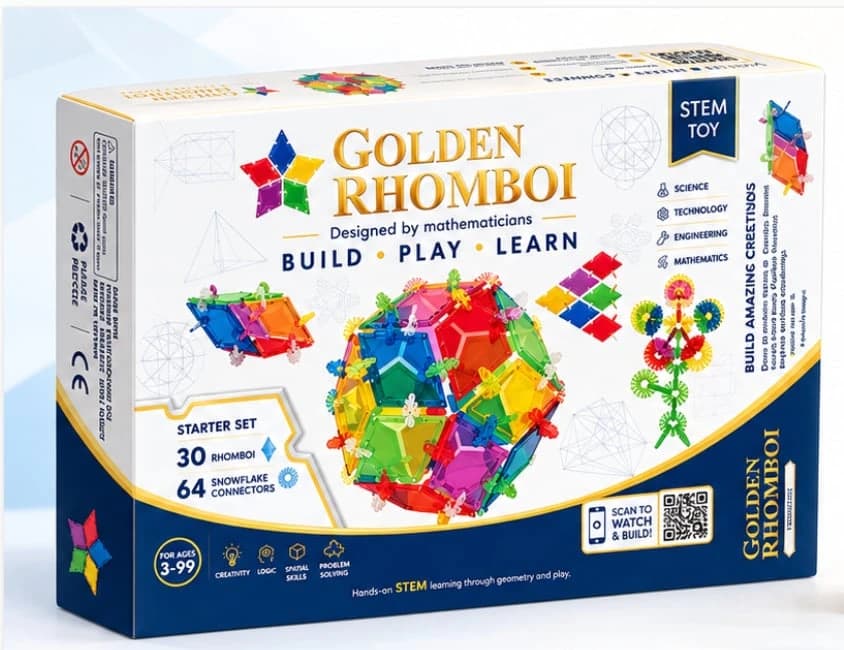
| Rhombic triacontahedron | 30 | 60 | 32 | 2 | Starter Set Box (30 pieces) |
| Rhombic hexecontahedron | 60 | 120 | 62 | 2 | Pro Set (60 pieces) |
In the triacontahedron every pair of neighbouring faces meets at a dihedral angle of exactly 144°, and the solid has full icosahedral symmetry: 6 five-fold axes, 10 three-fold axes and 15 two-fold axes, 120 symmetries in all when reflections are counted [4]. It can even be cut into 20 golden rhombohedra, 10 acute and 10 obtuse, a classic dissection that ties the whole family together.
Rhombic Triacontahedron
30 Rhomboi · the golden ball
5. Quasicrystals: the golden rhombus in science
In the 1970s Roger Penrose found tiles that cover the plane without ever repeating [5]. One version uses two rhombs with angles of 72° and 36°. They are not golden rhombi, but φ rules them as well: in a large patch there are φ times as many fat rhombs as thin ones. Robert Ammann, and independently Peter Kramer and Reinhardt Neri [6], carried the idea into three dimensions: space can be filled without repetition by the acute and the obtuse golden rhombohedra, whose faces are exactly our golden rhombus.
Nature got there too. In April 1982 Dan Shechtman saw sharp ten-fold diffraction patterns in a rapidly cooled aluminium–manganese alloy, a symmetry that was believed to be impossible for crystals. The discovery, published in 1984 [7], was met with disbelief, but it changed the very definition of a crystal and earned Shechtman the 2011 Nobel Prize in Chemistry. Three-dimensional tilings by golden rhombohedra became one of the standard models of these icosahedral quasicrystals.
6. Design analysis: why the golden rhombus makes a great toy
- One piece, many worlds. Children learn a single tile. Every rhombus tiles the plane, so flat patterns always work; thanks to the golden angle the same tile also closes into polyhedra with icosahedral symmetry.
- Corners that count. The two angles become two numbers children discover on their own: five sharp corners make a star, three wide corners make a round corner. Counting turns into geometry.
- Edges that hinge. Snowflake connectors clip onto the middle of each edge and let neighbouring pieces meet at any angle: 180° on the table, 144° in the triacontahedron. One joint serves both flat and 3D builds.
- Transparency shows the maths. Coloured, see-through faces reveal the hidden axes of symmetry and the overlapping stars inside the hexecontahedron.
- A proof you can hold. When the thirtieth piece clicks into place, Euler’s formula and Descartes’ theorem have been checked by hand: there is no other way for the ball to close.
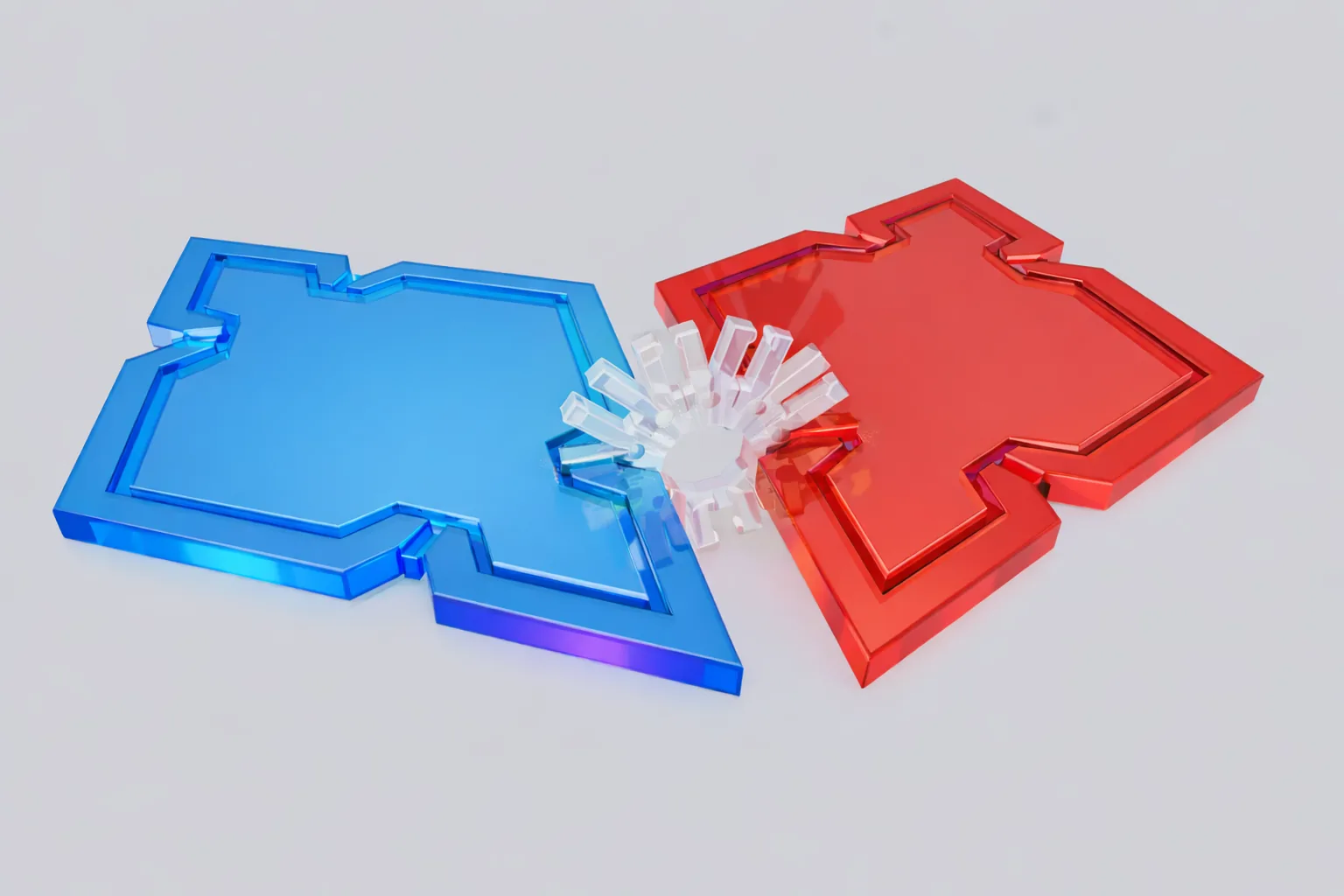
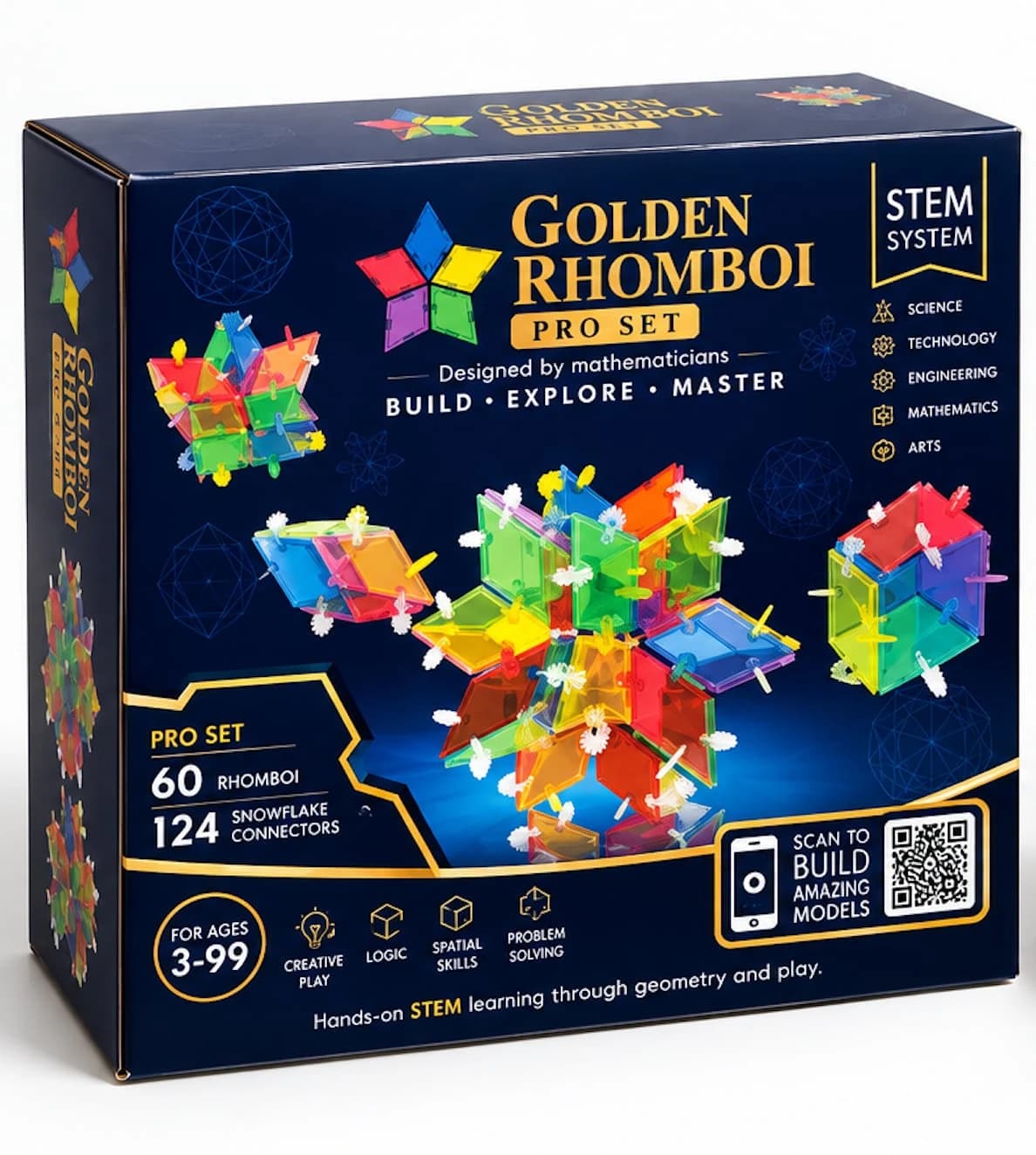
Table 2 maps what children do with the pieces at each age to the mathematics underneath. The progression is natural because every stage uses the same piece: only the questions change.
| Ages | What children do | The mathematics behind it |
|---|---|---|
| 3–5 | Join pieces, sort colours, make the five-piece star | Counting, shape recognition, rotational symmetry |
| 6–9 | Build flat patterns and the six-piece rhombohedron | Tessellation, angles, from 2D nets to 3D solids |
| 10–13 | Build the 30-piece ball, count faces, edges and vertices | Euler’s formula, ratio and proportion, the golden ratio |
| 14+ | Measure angles, compute defects, explore the hexecontahedron | Trigonometry (tan α = 2), Descartes’ theorem, symmetry groups |
7. Activities for home and classroom
Four short experiments that turn the results of this note into hands-on discoveries. Each needs only Golden Rhomboi pieces and, sometimes, a ruler or a protractor.
1. Find φ with a ruler
Ages 8+Measure the long and the short diagonal of a Rhomboi and divide one by the other.
How close to 1.618 do you get? Average the results of the whole class: is the average closer?
2. The missing wedge
Ages 7+Lay five pieces tip to tip on the table and measure the gap with a protractor. Then try three wide corners.
Why is the first gap about 43° and the second only about 10°? What happens when you close each gap?
3. Euler’s counting game
Ages 9+Build the 30-piece ball. Put a small sticker on each corner as you count it, then count faces and edges.
Compute V − E + F. Try it again with the six-piece rhombohedron. What do you notice?
4. Fibonacci staircase
Ages 8+Build rows of 1, 1, 2, 3, 5, 8 and 13 pieces. Divide each row by the one before it.
Plot your ratios like Fig. 1. Which number are they racing towards?
8. Conclusion
A single condition, diagonals in the ratio 1 : φ, fixes every property of the golden rhombus: an acute angle whose tangent is exactly 2, a side equal to sin 72°, and angle defects that make five pieces rise into a star and thirty pieces close into a ball. The same tile sits at the heart of Kepler’s triacontahedron, Bilinski’s dodecahedron and the rhombohedral models of quasicrystals. Golden Rhomboi puts this tile into children’s hands, so that the golden ratio is no longer a number to memorise but a shape to build with.
References
- [1]Euclid. Elements, Book VI, Definition 3 (c. 300 BC).
- [2]Kepler, J. (1619). Harmonices Mundi, Book II. Linz.
- [3]Bilinski, S. (1960). Über die Rhombenisoeder. Glasnik Matematičko-Fizički i Astronomski 15, 251–263.
- [4]Coxeter, H. S. M. (1973). Regular Polytopes, 3rd ed. Dover.
- [5]Penrose, R. (1974). The role of aesthetics in pure and applied mathematical research. Bulletin of the Institute of Mathematics and its Applications 10, 266–271.
- [6]Kramer, P. & Neri, R. (1984). On periodic and non-periodic space fillings of Eᵐ obtained by projection. Acta Crystallographica A40, 580–587.
- [7]Shechtman, D., Blech, I., Gratias, D. & Cahn, J. W. (1984). Metallic phase with long-range orientational order and no translational symmetry. Physical Review Letters 53, 1951–1953.
- [8]Markowsky, G. (1992). Misconceptions about the golden ratio. The College Mathematics Journal 23(1), 2–19.
- [9]Livio, M. (2002). The Golden Ratio: The Story of Phi, the World’s Most Astonishing Number. Broadway Books.
- [10]Grünbaum, B. & Shephard, G. C. (1987). Tilings and Patterns. W. H. Freeman.